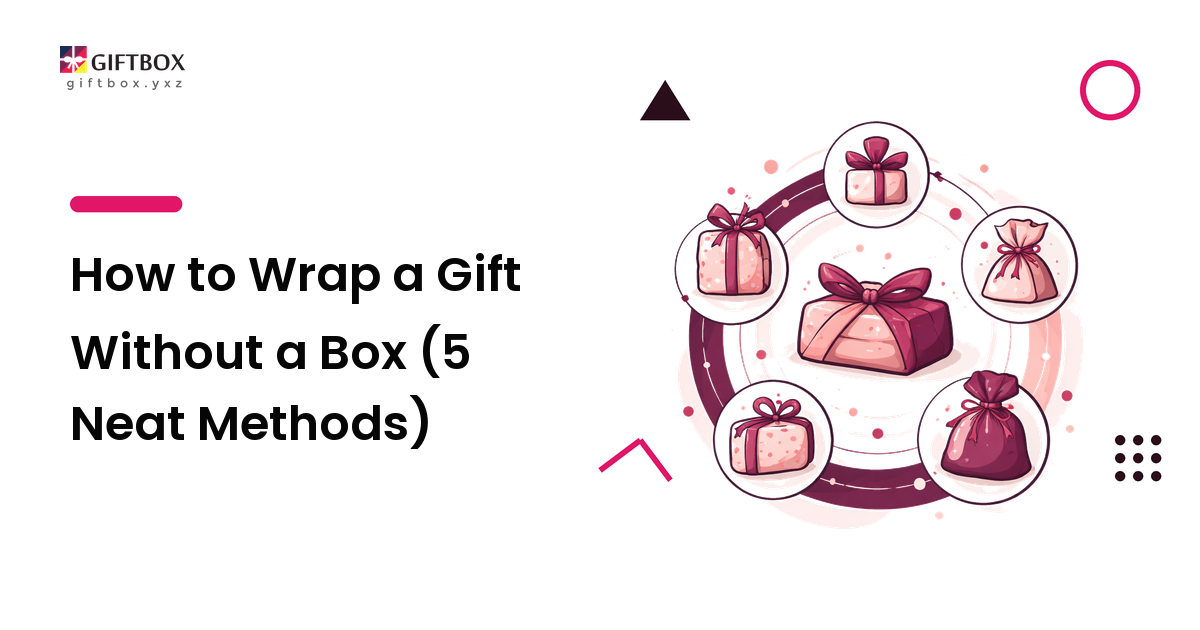
Out of boxes, or holding something that never came in one? You don't need a box to wrap a gift well — you need to match the method to the item's shape. A soft sweater, a wine bottle, and a hardcover book each want a different technique, and forcing any of them into the crisp folded corners that only suit a rigid rectangle is exactly why box-free wrapping usually looks messy. Below are five dependable methods, a quick chart to pick the right one in seconds, and a few finishing moves that make a no-box wrap look deliberate instead of improvised.
Quick answer: match the method to the shape
The whole trick is choosing the technique that suits what you're actually holding. Skim the chart, then jump to the method you need.
| What you're wrapping | Best method | Why it works |
|---|---|---|
| Soft or squishy (clothes, plush, a scarf) | Gather-and-tie pouch | No firm edges to fold against; gathering turns shapelessness into a feature |
| Truly odd or awkward shape | Furoshiki fabric wrap | Cloth conforms to any contour and needs no tape |
| Round (bottle, mug, candle) | Cylinder roll | Rolling plus twisted ends fit a curved surface neatly |
| Small bits or several little things | Homemade paper bag | Contains loose items and gives you a handle to carry |
| Flat and rigid (book, frame, tablet) | Flat-parcel fold | Already has clean edges, so it wraps just like a box |
What you'll need (a two-minute setup)
You almost certainly have a workable wrapper already. In rough order of how well they hold a crease and photograph:
- Paper: a sheet of wrapping paper, kraft paper, or even clean newsprint. Kraft takes a sharp fold and hides fingerprints.
- Fabric: a scarf, bandana, tea towel, or a half-yard of cotton for furoshiki.
- Tissue: two or three sheets for padding anything delicate.
- An emergency option: a paper grocery bag turned unprinted-side out is instant kraft paper.
For tools, keep it simple: double-sided tape if you have it (it hides the seam; regular tape is fine), ribbon or twine or a strip of the same fabric, scissors, and a gift tag or sticker to finish. That's it — no box required.
Method 1: The gather-and-tie pouch (soft and odd shapes)
Best for sweaters, scarves, plush toys, and anything squishy that has no edges to fold against.
- Lay a square of paper, or two layered sheets of tissue, on the table print-side down.
- Set the item in the middle. If it's floppy, fold or roll it into a compact mound first so the pouch looks intentional rather than lumpy.
- Bring all four corners up to meet above the item.
- Gather the paper into a neck just above the item and cinch it with ribbon or twine. Fluff the top into a small crown.
Why it works: gathering hides an irregular shape instead of fighting it, and there are no corners to fold. For anything breakable, pad it with tissue before you cinch.
Method 2: The furoshiki fabric wrap (anything, reusable, no tape)
Best for awkward shapes, breakables, and anyone who'll appreciate a wrap they can keep. Use a square cloth roughly two to three times the width of the item — a 20-inch (50 cm) scarf handles a book; a tea towel suits a mug.
- Lay the cloth flat as a diamond, with the item centered.
- Bring the bottom corner up and over the item and tuck it underneath; fold the top corner down over that.
- Take the left and right corners, draw them up to the top, and tie them in a double (square) knot.
- Nudge the knot so it sits centered, and even out the folds.
Why it works: fabric molds to any contour, needs no tape, and becomes a second gift. It's the most forgiving method here — if paper corners defeat you, this won't.
Method 3: The cylinder roll (bottles, mugs, candles)
Best for wine and oil bottles, tumblers, candles, and rolled posters.
- Cut paper tall enough to cover the item plus a few extra inches at each end.
- Lay the item on its side at one edge and roll it up snugly, then tape the long seam. Double-sided tape keeps it invisible.
- At the base, fold the overhang inward like you're closing a paper cylinder and tape it flat — or, for a bottle, stand it upright and gather the top instead.
- Cinch the open end (or both ends) with ribbon. Let the paper fan out candy-wrapper style, or twist and tie a single top for a bottle.
Why it works: rolling matches a round profile, and gathering the ends turns the hardest part — the openings — into the decoration.
Method 4: The homemade paper bag (small or multiple items)
Best for loose small items, gift cards, jewelry, or several little things that belong together.
- Wrap a rectangle of paper around a book or box to size the tube, overlapping the vertical edge, and tape that seam.
- Flatten the tube and fold the bottom up about two inches. Open that fold and press the corners in to form a flat rectangular base, just like a paper lunch bag; tape it.
- Crease the two sides inward to make gussets so the bag opens cleanly.
- Drop in your items (nest small ones in tissue), fold the top over twice, then punch two holes for a ribbon handle or seal it with a sticker.
Why it works: a bag contains loose bits a flat wrap simply can't, and you control the exact size instead of hunting for a box that fits.
Method 5: The flat-parcel fold (books and rigid rectangles)
Best for books, framed photos, tablets, and board games — anything already box-shaped.
- Center the item face-down on the paper, bring the two long edges up to meet in the middle, and tape.
- At each open end, fold the top flap down, crease the two sides into neat triangles, then fold the bottom flap up and tape.
- Sharpen every crease with a fingernail or the edge of a ruler for clean lines.
Why it works: a rigid rectangle already gives you the straight edges that make wrapping look professional. You never needed the box — just the shape it would have provided, which the item supplies itself.
Make a box-free wrap look deliberate
The methods get the gift covered; these finishing moves are what make it look chosen, not last-minute:
- Hide the joins. Run ribbon or twine over the seam and tucked ends so the eye lands on the bow, not the tape.
- Pick a texture, not just a color. Kraft paper with cotton twine, or a linen furoshiki, reads more intentional than shiny paper folded in a hurry.
- Add one natural accent — a sprig of eucalyptus, a cinnamon stick, a small ornament — tucked under the ribbon.
- Finish with a real tag and a handwritten line. That single detail tells the recipient the wrapping was a decision, not a fallback.
Wrapping is the last layer of the same presentation thinking that goes into a good bundle. If you're assembling several items rather than wrapping one, the structure matters as much as the paper — see our guide to building a gift box that feels intentional.
FAQ
How do you wrap a gift without a box or a bag?
Match the method to the shape: gather soft items into a paper or tissue pouch, wrap odd shapes in a fabric furoshiki, roll bottles and mugs candy-wrapper style, and fold books as a flat parcel. None need a box — a box only supplies edges you can borrow from the item itself when it's already rigid.
What can I use if I don't have wrapping paper?
Kraft paper, clean newsprint, a paper grocery bag turned inside out, tissue paper, or fabric such as a scarf or tea towel. Fabric and kraft often look more intentional than glossy paper, and a furoshiki cloth doubles as part of the gift.
How do I wrap an odd-shaped gift neatly?
Stop trying to fold flat paper around curves. Use the gather-and-tie pouch or a furoshiki wrap — both conform to any shape and hide irregular contours in gathered fabric or paper instead of fighting them with creases that will never sit flat.
How do you wrap a bottle without a box?
Roll it: cut paper a few inches taller than the bottle, roll snugly and tape the seam, fold or tuck the base flat, then gather the top and tie it off with ribbon. A fabric wrap knotted at the neck works just as well and needs no tape at all.
Is fabric wrapping (furoshiki) actually better than paper?
For odd shapes, breakables, and reuse, yes — cloth molds to anything, needs no tape, and becomes something the recipient keeps. Paper still wins for crisp-edged rigid items like books, where sharp folds look best. Choose by the item, not by habit.
Wrap what you have, beautifully
You don't need to run out for a box — you need the method that fits what's already in your hands. Match the shape to one of these five wraps, hide the seams under a ribbon, and add a written tag, and a box-free gift can look every bit as considered as a store-wrapped one. Want the gift inside to feel as thoughtful as the wrapping? Explore ready-made, curated boxes at Giftbox.