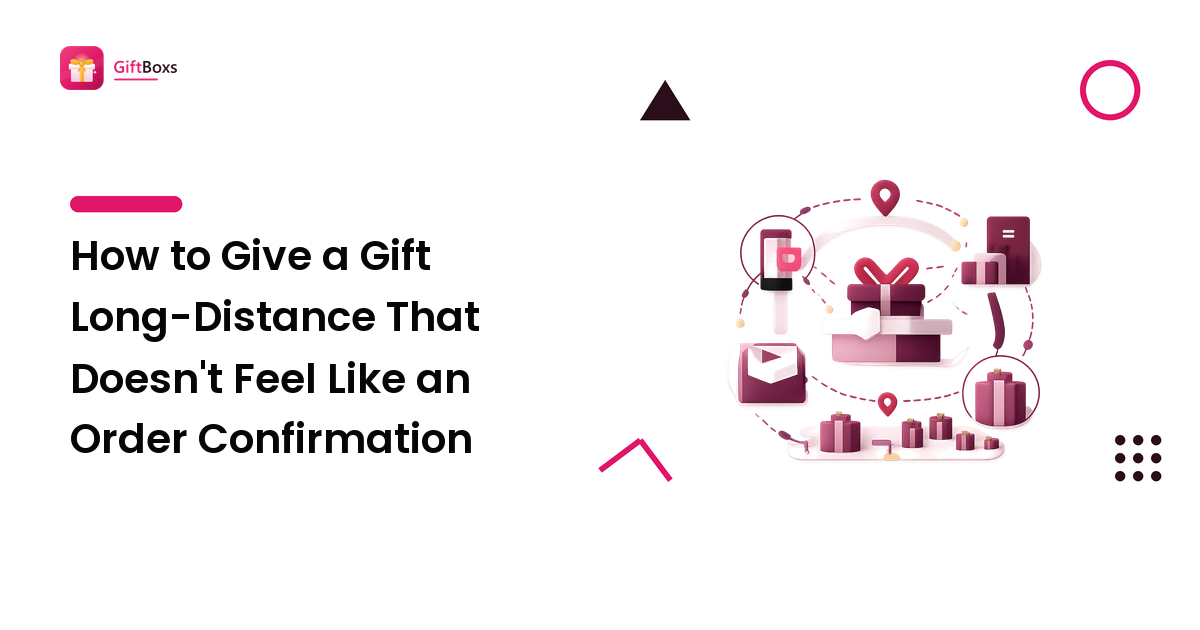
A gift given in person carries a lot of things that never make it into a shipping label: your handwriting, your face when they open it, the pause before you explain why you picked it. Ship the same gift across a country and all of that gets stripped out at checkout. What lands on the doorstep is a branded carton, a packing slip, and a name in the "gift message" field that reads like a form response — because it is one.
Here's the takeaway up front: the distance isn't the problem, the default is. Retail fulfilment is optimised to move an object, not to deliver a moment. So the job of long-distance gifting is to put back, deliberately, the three things the courier can't carry — something in your own hand, some context around the arrival, and your presence when the lid comes off. Do those three and a mailed gift lands as warmly as one handed over.
Why a Shipped Gift Reads as Transactional
It helps to be precise about what actually goes missing, because then you know what to replace.
The giver becomes invisible. When a retailer ships direct, everything the recipient touches was produced by a warehouse. The box is the retailer's, the tape is the retailer's, the note is a printed line in a system font. There is no physical trace of you anywhere in the parcel — and physical traces are what make a gift feel personal rather than procured.
The reveal loses its frame. In person, a gift arrives inside a conversation. By mail it arrives inside a Tuesday, between a utility bill and a package of socks the recipient ordered for themselves. Same object, no framing, and the brain files it accordingly.
Nobody is watching. Part of what makes giving good is the reaction — for both people. Unwrapping alone, the recipient has no one to react to, so the natural response becomes a thank-you text sent an hour later, which feels to them like an obligation discharged.
None of that is fixed by spending more. A costlier item shipped bare still reads as a transaction; a modest one that arrives with a handwritten card and a phone call does not.
Decide Who Opens the Box First
This is the single biggest fork in the road, and most people take it by accident at checkout. Either the retailer ships straight to your recipient, or it ships to you and you send it on. The right choice depends on the occasion, the distance and how much time you have.
| Approach | Best when | The trade-off |
|---|---|---|
| Ship direct from the retailer | Time is short, the item is bulky or fragile, or it's crossing a border where a second leg adds cost and delay | You never touch it — no handwritten note, no chosen wrapping, and a real chance a priced invoice is inside |
| Ship to you, then send it on | The relationship matters more than the logistics, and you have a week or more | Costs more, takes longer, and adds a second chance for transit damage |
| A hybrid: direct-ship the bulk, mail the personal part | Heavy or perishable gifts, or several items from different places | Two arrivals to coordinate, so tell the recipient which comes first |
That hybrid is underused and it solves most cases. Let the heavy or fragile thing travel the shortest possible route from warehouse to doorstep, and post the card, the photo and the small hand-chosen extra separately in an envelope timed to land the same day or just before. The recipient gets a parcel and something with your handwriting on it, and you never paid to ship a candle twice.
If you do repack and send it yourself, the physical side has its own rules — a sacrificial outer carton, cushioning on all six sides, liquids bagged upright — and they're covered in detail in how to pack and ship a gift box. Get that part right and the presentation you built survives the journey.
Put Something Human Inside the Box
The cheapest upgrade in long-distance gifting is also the most reliable: include one object that could not have been produced by a warehouse.
- A handwritten card, laid on top of the contents. It should be the first thing seen when the lid lifts, not tucked under the tissue where it gets found last. Slightly imperfect handwriting reads as sincere in a way a typed gift-message field never will.
- A printed photo. Digital images are abundant and weightless; a physical print is neither, which is exactly why it registers. One photo of the two of you does more than a paragraph.
- A small object with a story. A postcard from where you live now, a packet of the tea you drink, a book with your notes in the margin. Distance makes ordinary local things interesting.
- Packaging you chose. Even inside a plain shipping carton, a ribbon and your own tissue paper signal that a person assembled this. If the retailer wrapped it, you didn't.
The card does more work than most people realise: it's the only part of the parcel carrying your voice, and the part recipients keep. Name the occasion, then add one detail that could only be about them — why you chose this gift, a memory, something you know they're in the middle of. That line is what separates a present from a delivery.
Control the Moment It Arrives
Arrival is the part you can shape without spending anything, and it's the part almost everyone leaves to the tracking system.
Tell them something is coming. The old instinct is to keep it secret, but a surprise you can't be present for often lands as confusion — an unexpected box, opened while distracted, half-attention paid. A message the day before ("something's arriving tomorrow, open it when you have a minute") costs you nothing and buys the gift a proper audience.
Aim early, not exact. Target arrival a few days before the occasion rather than on it. Carrier estimates are ranges, weather happens, and a gift that turns up two days early is a pleasure while one that turns up two days late is an apology.
Be there when it opens. Set a video call and let them unwrap it while you watch. This is the closest available substitute for handing it over, and it restores the reaction both of you are actually there for. If a call isn't possible, ask for a photo — small, but it turns a one-way delivery into an exchange.
Mind the time zones. Work out what "the morning of" means where they are, not where you are. A birthday message timed to your afternoon can arrive at their 2 a.m., and a gift call scheduled without checking lands mid-workday. Check the offset once and note it somewhere.
When Nothing Can Be Mailed
Sometimes shipping is the wrong tool: the distance is too great, customs are unpredictable, the person is moving, or you're a few days out with no realistic transit window. There are still good options, and they're better than a hastily emailed voucher.
- Buy something local to them. A delivery from a bakery, florist or restaurant in their city arrives fresh, skips international shipping entirely, and shows you looked up where they actually live.
- Book an experience where they are. A class, a match, a museum membership. It also gives them something to tell you about afterwards, which is its own kind of contact.
- Give a service that removes a chore. A cleaning visit for new parents, a grocery delivery during a hard week, a meal for someone mid-move. Practical gifts read as attentive when the giver clearly knows what the recipient's week looks like.
- Make the digital gift physical anyway. If it has to be a code or a voucher, post a card with the code written inside rather than forwarding the automated email. Same value, entirely different arrival.
The common mechanism: each of these puts a real event in the recipient's day rather than a notification on their phone — which is what a gift given in person does too.
Small Habits That Keep It From Feeling Like an Order
- Remove or suppress the priced invoice — check inside the packaging, not just on top, and remember an international customs label displays a declared value on the outside.
- Confirm the address in the recipient's own words rather than reusing one from an old order; long-distance is exactly where stale addresses hide.
- Don't send the tracking number as the message. "Here's your tracking" is a logistics update, not a greeting.
- Skip the retailer's pre-written gift-message options, and say so if two parcels are coming, so nobody opens the card-only envelope wondering whether that was the whole gift.
- When distance is permanent rather than a one-off, plan a few dates across the year instead of one big December parcel. Frequency beats size over distance, because what's actually being sent is attention.
FAQ
How do I send a gift long distance without it feeling impersonal?
Add back what shipping strips out. Include something handwritten, tell them the parcel is coming, and be present — by video call or at least a message — when they open it. Those three moves matter more than what's in the box.
Is it better to ship a gift directly from the store or send it myself?
Direct shipping is better for bulky, fragile or perishable items, tight timelines and cross-border sends, because it's one short journey instead of two. Sending it yourself is better when you want to add a note and your own wrapping. The hybrid — direct-ship the gift, post the card separately — usually gets both.
What should I send someone who lives in another country?
Favour light, non-restricted, non-perishable items, or skip shipping and buy something local to them, such as a food delivery or a booked experience. If you do ship, describe the contents accurately on the customs form and let them know duty may be payable on arrival.
How far in advance should I send a long-distance gift?
Aim to arrive a few days before the occasion, then work backwards: slower-end transit time, retailer handling if someone else is dispatching, your own packing time, plus a buffer. Look up the carrier's current cutoff for that destination rather than relying on a remembered date.
What are good long-distance gift ideas for a partner or close friend?
Things that create shared time or a physical trace: a printed photo book, a food or drink box you can open together on a call, a subscription that arrives monthly as a recurring reminder, or a letter posted the old-fashioned way. Recurring gifts work particularly well over distance because they repeat the contact.
Distance Is a Logistics Problem, Not a Feeling Problem
The parcel will get there — courier networks are good at that part. What they can't do is carry your handwriting, frame the moment, or stand next to the person while they pull the ribbon. Those are the parts you add on purpose, and they're the parts that decide whether the gift reads as a present or a fulfilment notice.
Start with a box that's already curated so your effort goes into the note and the timing rather than the sourcing — browse the occasion and recipient collections at Giftbox and let the personal part be the part you handle.